Visionary Fine Artist, Gender Activist ~ HHHAS, MFA, MSW, LCSW
 AfraShe Asungi™
& Afrakan® SpiraKultural™ Philosopher
& Wimmin's™ Spirituality Teacher

Her Innermost SheScapes™
AfraShe Asungi, HHHAS, MFA, MSW, LCSW
P O Box 91533
Long Beach, CA 90809-1533
SheKultu

- Wellcome ~ Home
- Her Innermost SheScapes: About AfraShe Asungi
- Home To Mama ~ An Article
- AfraShe's SheCreative Heartscape Portfolio

- AfraShe's Array of Services
- About Our AfraKamaatik Sistahhood : MAMAROOTS: Ajama-Jebi
- KaaSheBaa Home
- Links To Our Other SpiraKultural Offerings
- AfraShe's Events, Exhibits, Workshops & Special Offers
- AfraShe's Video Gallery
- Frequently Asked Questions
- Related Reviews, Articles & More
- AfraShe's Mailing List For Events & Special Offers
- Our SheCreative eStore Gallery
- Links To Artist Colleagues & Mentors
- Other Related Links
- Making Contact

Home To Mama™ ~ An Article
About AfraShe Asungi™ . . .


:<>:<>:<>:<>:<>:<>:<>:<>:<>:<>:<>:<>:<>:<>:<>:<>:<>:<>:<>:<>:<>:<>:
Home To Mama™ :
The Company of a Priestess . . .
by Lucy Jane Bledsoe

:<>:<>:<>:<>:<>:<>:<>:<>:<>:<>:<>:<>:<>:<>:<>:<>:<>:<>:<>:<>:<>:<>:

I met AfraShe Asungi, founding priestess and head philosopher of Mamaroots, an international metaphysical community, entirely by accident.
Or was it?
The day before, a migraine had struck my left eyeball, causing a large blind spot surrounded by flashing jagged arcs of light in the left side of my vision. I took my pills and thanked the goddess for finally providing a migraine-masking drug, and my MD for prescribing it for me, and was back in the saddle within a hour.
But I was changed. I'm always changed, just a little, by each migraine. They remind me of my vulnerability, of the preciousness of pain-free moments, and somehow, perhaps ironically, they also make me feel stronger, that I can take the steps I need to take, in spite of setbacks, to reach my goals.
Which was why, a few minutes after recovering from the migraine, I was driving down Shattuck Avenue with a serious intent. Several months ago, I applied for a grant that I very much wanted.
The waiting has been difficult, and recently, my hope had been slipping into despair. I read the migraine as an expression of that despair and my recovery from it as a sign that it was time to do something constructive about that grant. I needed to buoy up my spiritual support.
I remembered that the shop, which I had visited a couple of times before, was on the right side of the street, going south, somewhat past Alcatraz, and near a dry cleaners. I found it and parked. But the shop was closed for the day.
I counseled myself to not curse out a spirituality store. Definitely a bad idea. Then I decided that I was being tested. This was part of the trial. Did I want the grant bad enough? Was I willing to drive to Oakland twice and without an attitude? The answer was yes, I was.
I was back the next day. This time, though the sign said OPEN, the door was locked. I began to realize that the shop looked nothing like my memory of it. And yet, a strange persistence had a lock on my will. I jiggled the handle, peered in the window, and soon the door opened.
The first thing I noticed about the woman holding the door was her engaging gap-toothed smile. She asked how I was doing and stepped back so that I could enter. "Hey," I said, still mentally insisting that I knew where I was, "you must have changed everything around in here. It's completely different from last time." "Noooo." She dragged the word out softly, and I could see her wondering where I thought I was.
I didn't feel so much disoriented as plopped. Like I had leapt over my intention and landed somewhere else. It was a little like the inverse of the migraine experience, in which I am jettisoned out of the reality that, moments ago, I had perfect confidence in.
Only now, rather than being jettisoned into a mini-hell, I had landed in a small room, full of lovely objects, in the presence of a priestess, though I didn't yet know that part. All journeys are like that: you go with a certain intent, which is often never met but replaced by something at least as wonderful.
And yet, at this moment, I hadn't quite let go of my original intent. I twirled in circles, babbling out loud about how nothing looked at all like it did a few months ago. Besides the great smile, the shop's proprietor  wore round, colorful glasses and loose dreads ornamented with shells and beads.
The droning television, as well as the comfy couch and easy chair surrounding a warm rug in the middle of the room, made me feel as if I had dropped into someone's living room.
But no, the room was filled with African goddess images, paintings, cards, posters, candles, incense, herbs, gemstones, bath crystals, and books. Clearly a shop.
"I bet," the woman finally ventured, "that you're thinking of Ancient Ways on Telegraph Avenue." She was right: I was thinking of Ancient Ways, the shop that sells all manner of spiritual supplies. "You're in AfraTaaset™."
She handed me a card that read, "AfraTaaset™: AfraGoddess™ House & AfraWellness™ Center." The card described the shop as an Afrakan™ Spiritual Marketplace. She introduced herself as AfraShe, and told me that her shop had opened in February, less than a year ago.
Perhaps I had intended to visit Ancient Ways, but I'm no pagan dummy. For a reason I wasn't about to question, I had landed here, in a store I didn't even know existed, in an entirely different neighborhood from the one I thought I was visiting.
In fact, I came here not once, but twice. So I told AfraShe about my grant proposal, and that I wanted to buy a candle to burn as a way of eliciting spiritual aid.
She helped me select a candle, suggested I place it on a specific number of bay leaves and in a bowl of water. In the meantime, we talked about her shop, art, and philosophy. I learned that AfraTaaset™, the gallery, was the physical face of a larger endeavor, a community of African American women, called Mamaroots™.
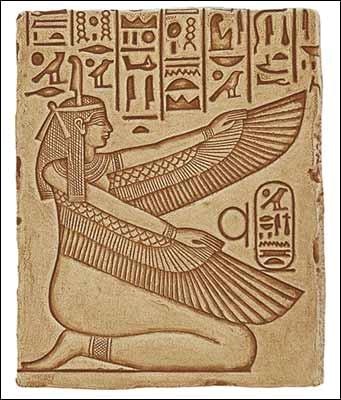
According to its literature, Mamaroots™ is "a sistahood of wimmin™ of Afrikan ancestry devoted to recreating an Afrikan-female-centered-self-loving-community." AfraShe emphasized that the group isn't exclusive, just focused. Any woman who is willing to be a part of that focus is welcome.
She points out that, "All humanity comes from Africa. We're one race. We don't feel we can limit who feels kindred to the philosophy of Afracentricity™, which is going back to the Mamaroot™, and going back to our African origins."
"So if someone is willing to leave their Eurocentric views outside the door, and take on the views and attitudes that we've set up; which we require of anybody, regardless of their heritage, then they're welcome to be a part of the organization."
AfraShe views Mamaroots™ not so much as a pagan spiritual practice as a metaphysical philosophy. "The Afrakamaatik™ Tradition is a predynastic Nubian tradition, matriarchical and Goddess-centered."
Of most importance is the code of standards that prescribes how members function with one another. This code is a modern translation of the ancient codes that were known as the 42 confessions of Maat, an African Goddess.
The philosophy underpinning Mamaroots™ grew out of AfraShe Asungi's work as an artist. In the 1970's, she created a Goddess Series™, "in which I did 10 African Goddesses, modern and traditional images, that started the discussion of, 'Is there an African Goddess?'"
 "And we evolved from there. . . I needed to see images of [Strong, Self-contained and focused] Black women, and so I reached into the mythologies, the herstories, and created the series in order to bring images to the present-day."
Her African Goddess paintings provided the images that stimulated her developing philosophy, and her reinterpretations of ancients teachings. "My whole statement as an artist is that art makes change. Visuals are a way of changing and transforming the world."
Mamaroots™ has three levels of membership. A general congregation doesn't necessarily practice the teachings but supports the organization. Self-initiates are women who want to practice the teachings.
To become a priestess, a woman must do the work of a self-initiate, which involves taking care of one's personal issues, and then making a lifetime commitment to serving the community, the goddess entity, and the metaphysics. A group of elders decides who can become a priestess.
"Our whole idea is community and to build community," says AfraShe. "The role of the priestess is to belong to the community actively . . . A priestess should be prepared to move beyond her own needs."
She emphasizes that "it's okay to not be a priestess. If you get your self in order, that's a great commitment. Then, if you feel the need and the desire, and it's an incredible responsibility, to want to help others, to offer your services to others--and priestesses are servants--it takes a lot of patience and mastery of oneself to handle other people."
"It's an honor just to work on oneself. Not in a selfish sense but in the sense of, if I find out who I am, then I can only benefit others. If I work on myself, I am automatically going to be an asset to all everyone I come in contact with."
Though some of the specific practices are not to be shared with the public, AfraShe stresses, over and again, the idea of commitment to community being a primary component of the organization, a component that does not always go down easy for some women.
"Mamaroots is real structural. Most people are kind of shocked when they see that we're REAL structured."
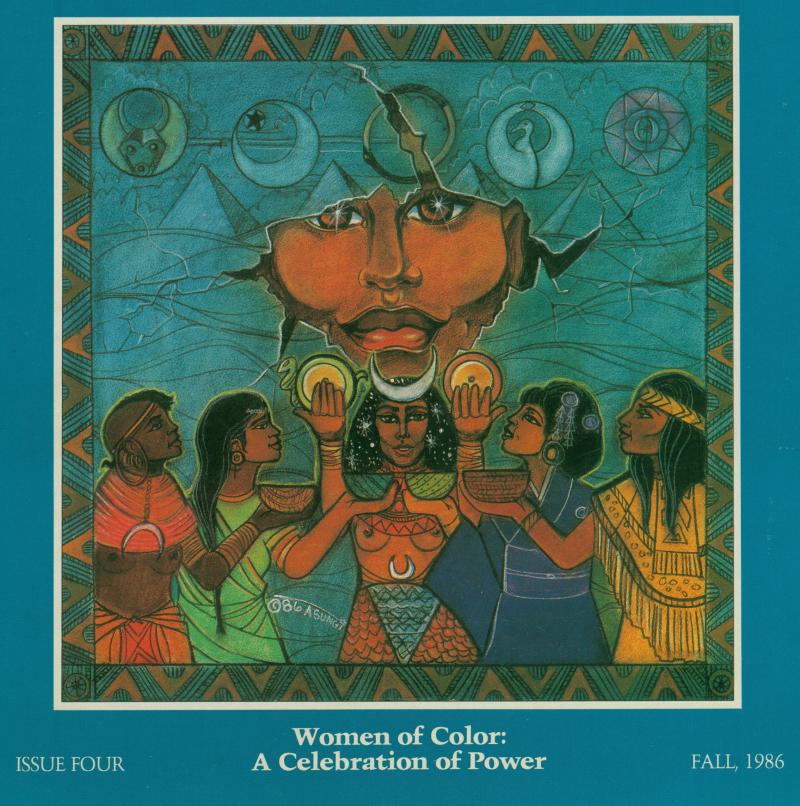
WOC Celebration:
Calling Her Forth Again Through Awakened Sistah-Unity™.
© 1986-2018. Asungi Productions.
AfraShe loves being in her new Oakland neighborhood and watching the responses of the motley crowd, including me, that wanders into her shop. "Definitely we are controversial," she says. "We're Goddess-centered. We're African-centered. We're Black woman-centered."
"We don't limit how women honor themselves and each other, or love each other. We're not homophobic. We don't follow the general tenets of what it means to be a woman, traditionally."
"Women," she said, "tend to be more upset than men by what she is doing. The women who tend to believe their role is to be subordinate to men are taken aback by the audacity of us . . ."
"The men who don't necessarily agree, don't bother. The most overt negative responses I've gotten so far have been from Black women. The woman-centeredness, the Goddess-centeredness is actually scary to them."
Before coming to Oakland, AfraShe lived in a number of cities, including Los Angeles, Seattle, Toronto, and Tucson, establishing Mamaroots™ communities. She says, "I didn't intend to come to Oakland. I'm not quite sure how to explain the work, it's just that I know I'm supposed to be here."
"It doesn't make much logical sense except that I follow the path I'm led to. I was told this was where to do the work next. My next physical center needed to be in Oakland."
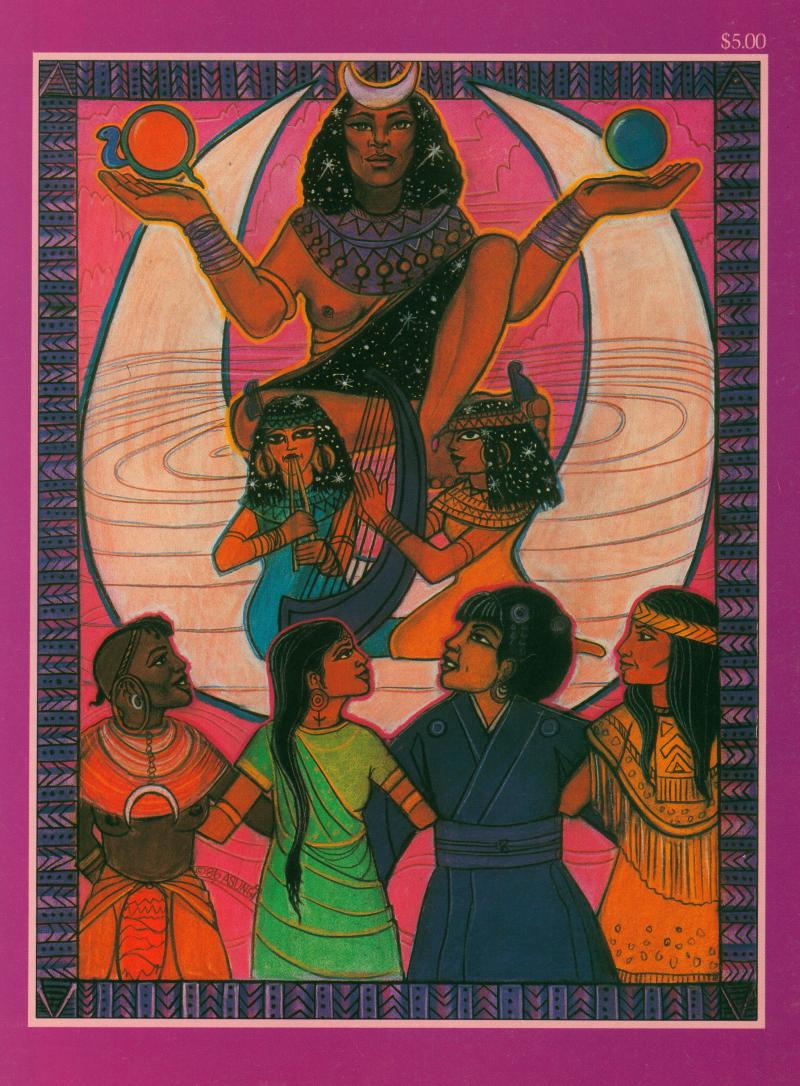
The gallery and center, AfraTaaset™, offers on-going classes and lectures on such topics as AfraMama™ celebrations and mythology, dispelling Afraphobia™, introduction to herbs, candles and sacred crystal use, AfraMama™ prayers and meditation techniques.
With a wonderful supply of posters, cards, jewelry, and books, the shop is a great place to buy gifts or simply visit to view the art.
AfraShe hopes that her gallery and shop, where everyone is welcome, will contribute to the community at large. "Alchemy starts with visuals. If you come into this shop, and you see it, and you talk to me, you come away with a new view. People don't come in here and leave unchanged."
"I like to think it's about us following our philosophy and presenting a view of African Goddess metaphysics that's pretty different than what most people would ever think of them as, if they thought of them at all. . . ."
"The intent is to bring a new view of what African women coming together might be, what it means to practice an African system."
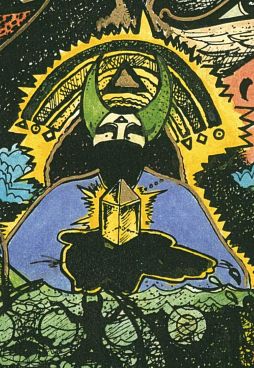
Image Detail © 1990-2018 Asungi Productions
Spending a couple of hours with AfraShe revitalized me. Her intelligence, her humor, but most of all her vision for building an international community of self-reliant, African goddess worshiping women gave me the kick in the spiritual pants I needed.
Other people's faith can be contagious, no matter if their faith doesn't match yours goddess for goddess. Sometimes it's healing to simply be in the presence of someone who is confident about her own answers, who emanates good will and integrity, who has dedicated her life to doing right by herself and others.
I drove home slowly, still wanting that grant, badly, but my own vision of desire had been expanded: rather than seeing the grant as a tiny spot of light at the end of a long dark tunnel, it was now more like one tree I'd like to reach in a wide vista, with lots to see along the way.
It did me good to spend some time in the company of a priestess.
This article is reprinted from 1998 Bay Express, with permission by the author.
© All Rights reserved.
*************************************************************
2010-18 MAMAROOTS/ Asungi Productions. All Rights reserved. Permission to quote, cite, reprint granted if source, contact info and copyrights are included in the body of the reproduction. All rights reserved on all Trademarked and registered Terms.
 Copyright 2000-2021 Asungi / MAMAROOTS® / SheKultural™ Productions
All original art & text © copyright Asungi/ MAMAROOTS productions.
All rights reserved on all Copyrighted, Images ~Trademarked or Registered Terms /images /Marks.
 Permission to quote, cite, reprint granted if source and copyrights are included in the body of the reproduction.
We Support Diversity, Equity and Humin Dignity . . .

Website design by AfraShe Asungi, MFA, LCSW
AfraShe Asungi, HHHAS, MFA, MSW, LCSW
P O Box 91533
Long Beach, CA 90809-1533
SheKultu